
Street artist engagée à l’international, Kashink bouleverse les codes esthétiques et nous pousse à remettre en question les normes sociales. Ses œuvres colorées sont une véritable ode à la diversité. Artistik Rezo nous emmène à sa rencontre.
Pourquoi la moustache ?
Ça fait 6 ans que je la porte tous les jours, toute la journée, dans toutes les circonstances. Tous les matins je me maquille, me coiffe, m’habille, puis trace cette moustache. Elle fait partie de mon rituel quotidien. Je la portais déjà depuis deux, trois ans avant mais seulement pour des événements, des performances en live, live painting, des vernissages ou des moments où j’étais dans un rôle « d’artiste », puis je me suis rendue compte qu’en terme d’identité je me retrouvais vraiment à travers ce type de maquillage et dans cette manière de me présenter au monde, qui est vraiment à l’inverse de ce qu’on attendrait d’une femme. La moustache ne souligne pas la féminité, au contraire, puisqu’on nous pousse à l’enlever, la décolorer, en avoir honte comme si ce n’était pas naturel alors que ça l’est.
Finalement c’est très facile de retourner les codes (traditionnels des deux traits symétriques sur un visage, sourcils ou eyeliner) à l’inverse de ce qu’on nous impose. Ça me satisfait énormément de mettre ce grain de sable dans l’engrenage en questionnant toutes ces normes. La féminité, qu’est-ce que c’est ? C’est difficile à définir en fait, et quand on commence à la définir on parle souvent de séduction, du fait d’être sexy, attirante, comme si la féminité ne pouvait être définie que sur une notion de séduction et d’image améliorée de nous même. C’est mon rôle d’artiste de questionner les normes sociales. Offrir une vision du monde personnelle et parfois dissonante, c’est ça l’art.
Tu remets en question le genre féminin, mais aussi masculin, puisque dans tes fresques tes personnages ne sont ni des hommes, ni des femmes, tu bouleverses tous les codes. Tu défends l’humain en général ?
Je défends une certaine forme d’intersectionnalité. Je pourrais faire des peintures de femmes fortes comme on en voit beaucoup, et je me suis beaucoup posé la question quand j’ai commencé à peindre. J’avais ces questionnements sur la représentation d’un corps et d’un visage féminin avec des attributs « féminins » : longs cils, petit nez, grosse bouche, longs cheveux etc… alors que toutes les femmes n’ont pas de longs cils et une grosse bouche. C’est encore une manière de formater une image de la féminité. Je n’avais pas envie de coller à cette idée.
C’est difficile de casser les codes esthétiques, nous sommes tellement pétris de sexualisation du corps féminin dans toutes ses représentations picturales. J’ai donc préféré rester uniquement sur des portraits de visages pour essayer de déconstruire tout ces codes de représentation de la féminité en proposant quelque chose de personnel qui soit au-delà de la binarité mais aussi de l’origine culturelle. Mes personnages ne sont ni définis par une origine culturelle précise, ni genrés, ni limités dans leur esthétique. C’est vraiment important pour moi d’avoir une approche hyper large et hyper inclusive. Je ne veux pas que mon art soit réservé à une certaine catégorie de personne.
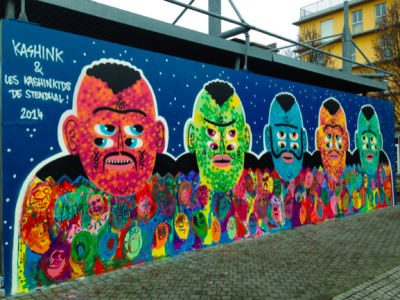
Ton bureau à toi c’est la rue, on entend partout que les femmes doivent faire attention lorsqu’elles se promènent seule, que ce n’est pas un lieu pour elles, comment as-tu réussi à t’imposer et à évoluer dans ce milieu urbain et masculin ?
Ça m’a pris du temps de me rendre compte de l’impact d’avoir pris cette décision de peindre dehors. J’avais vraiment envie de désobéir, c’est le premier truc qui m’a donné de l’énergie. J’avais envie de m’octroyer le droit de faire des choses que normalement je n’avais pas le droit de faire. Je ne voulais pas être dans la norme, dans le moule, je ne voulais pas rester à ma place. Quand des femmes voient que j’ai passé plusieurs heures/jours dans la rue à peindre elles mes disent qu’en voyant mon art, elles se rendent compte que oui c’est possible, nous aussi nous avons notre place ici. Je trouve ça hyper fort et ça me donne beaucoup de force car ça veut dire que ce que je fais est compris, qu’on aime ou pas ce que je fais en terme de style.
Ce qui est important c’est aussi le fait que j’aille à l’encontre de ce qu’on attend de moi en tant que femme dans cette société, dans laquelle, on le sait toutes, si tu traines dehors dans la rue, tu peux être une potentielle victime de violences ou de harcèlements. Ça on l’a toutes en tête, on le sait, c’est un acquis, un fait indéniable. Ce n’est pas quelque chose qu’on nous apprend, c’est quelque chose qu’on vit déjà inconsciemment, et que l’on se transmet de façon un peu inconsciente. On est en train de mettre des mots sur ce qu’on vit et ça c’est super puissant. Parler c’est reprendre sa place, et c’est une force fondamentale.
Qu’est-ce que tu penses des expositions exclusivement réservées aux femmes ?
C’est une vrai question. J’ai participé à des événements purement féminins. Par exemple une des premières expo à laquelle j’ai participé et qui à été marquante de mon parcours artistique, c’était à Miami en 2013, j’avais trouvé ça hyper cool, je rencontrais des femmes plus connues que moi, qui avaient marqué leur temps par rapport au graffiti, comme Martha Cooper qui était la photographe de graffiti dans les années 70 à New York, ou d’autres peintres comme Lady Pink, j’étais vachement fière. Puis petit à petit je me suis demandée si ça valait le coup de rester dans cette espèce de cadre qui peut être restreignant, il y a un peu un côté minorité alors que nous ne sommes clairement pas une minorité, au contraire.
Les derniers projets de ce genre que l’on m’a proposés, j’ai décliné, pour moi ça aurait plus de sens que se soit moitié-moitié, ou alors pour marquer le coup, une expo dans laquelle il y aurait une minorité d’hommes, pourquoi pas ?
En ce moment on peut entendre parler de “white feminism” et de “afro feminism”, toi qui essayes de mélanger toutes les cultures et d’abolir les barrières, qu’est ce que tu penses de cette dissociation ?
Je pense qu’il ne faut pas oublier qu’en tant que femmes blanches nous avons certains privilèges. Tu peux avoir une approche du féminisme totale, mais il faut quand même garder en tête que des choses peuvent se recouper et que si tu ne sais pas ce que ça fait, tu ne peux pas t’exprimer au nom des personnes racisées.
Je suis pour l’inclusion, totalement, je pense que c’est dans la force collective qu’on arrivera à changer les choses en profondeur. Mais je comprends que des femmes noires aient envie de parler entre elles, ça ne me choque pas du tout, il y a des choses que tu ne peux comprendre que quand tu es une femme noire. Il faut vraiment garder une ouverture totale et se dire qu’en tant que blanche, tu as des privilèges. L’accès à certaines choses est beaucoup plus facile quand tu es blanche, mais l’intersection est essentielle, c’est dans le travail ensemble qu’on peut faire avancer les choses en profondeur. Se soutenir les unes les autres c’est super important.
Quels sont tes projets, ton actu ?
Je continue à faire des voyages pour des commandes de murs. Je bosse aussi sur trois projets qui n’ont rien à voir avec la peinture spécifiquement. Le premier, c’est que je suis en train d’écrire un livre sur mon expérience avec cette moustache. J’ai récolté pas mal d’anecdotes, de moments que j’ai vécu, d’interaction avec les gens dans tous les pays où j’ai peint, depuis le temps que je le fais j’ai beaucoup de choses à dire. J’y ajoute ma réflexion personnelle sur comment tout ça a évolué. Je fais aussi des courts métrages, que je fais pour mon plaisir. Je trouve ça hyper satisfaisant de s’exprimer sur d’autres moyens, les courts métrages me permettent d’explorer autre chose artistiquement parlant. Ce sera toujours sur les thématiques que je transmets déjà dans mes peintures. Le troisième c’est de la musique, j’en ai beaucoup fait depuis le lycée et à une époque je chantais dans des groupes de métal, maintenant c’est plus électro et expérimental, mais ça me fait du bien de me reconnecter avec ça.
En parallèle de ça, avec des copines on a créé un groupe de peinture ouvert à toutes, nous sommes en mixité choisie. Pour la journée du 8 mars on a fait le grand mur en face de Chez Prune sur le canal Saint-Martin, aucun homme n’était invité sauf deux potes trans, et d’autres mecs étaient là pour nous soutenir, c’était vraiment cool.
Propos recueillis par Emma Mercier