
The street artist recounts his creative journey off the beaten track: a victorious urban movement in constant evolution. Artistik Rezo takes us to meet him.
Popay, can you tell us a bit about yourself and your background?
Born in Barcelona, I've lived in the Paris suburbs since I was 2, then in Paris when I was 10. Around the age of 15, I was drawn to graffiti, even though I was already interested in painting and comics. After graduating from high school, I failed the Beaux-Arts and Arts Déco entrance exams. So I continued to practice graffiti intensively until I was 23. After that, I started an internship at a special effects company, where I had a revelation about digital tools. In 1993, I was lucky enough to be trained on the film La cité des enfants perdus, which was decisive for my sensitivity to digital. Despite this, I stopped after a year due to my social incompatibility with this environment, and began to frequent the techno and squat scene. I started to re-socialize a little before my son was born, when I got back into computers and bought my first Mac with a graphics palette.
After my separation from my son's mother, I returned to the squatter family, living at La Miroiterie for 3 years. I was able to extricate myself and immediately took an apartment in Montreuil, where I lived for 10 years while working on my painting in an adjoining squat, Woodstock. When the squat closed, I moved to St-Maur-des-Fossés, where I live and work today.
Since 2011, I had also returned to the art market, which I had previously abandoned, supporting myself by working in illustration and graphic design for the underground music scene.
Since 2018, I've begun a monumental reconquest of the wall, this time transforming and adapting my production to paint more walls than I'd painted in my entire career as a graffiti artist, accounting for around 2000m2 between Ukraine, Spain, Belgium and France!
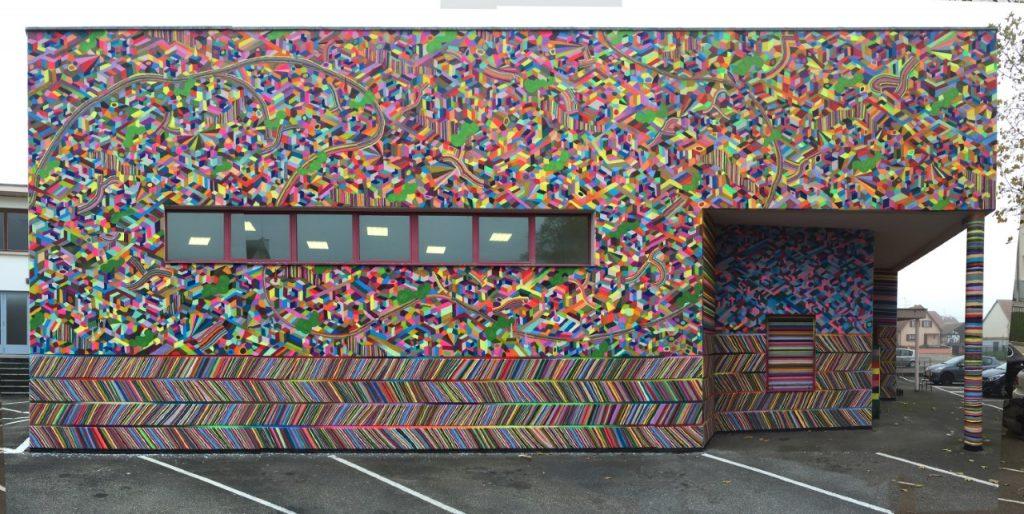
Your creations vary in medium: walls, canvases, posters, record sleeves... How would you describe your style?
Style is difficult to describe other than in images, and I'll leave that difficult task to the literary world. Roughly speaking, I think I've always tried to blur the lines, investing myself wherever I felt the appeal, with a particular concern to place as little importance as possible on coherence, or even to actively assert the incoherence of my choices. Probably as a reaction to the uniformity of the marketing approach of most art movements for, I can't say how long, but maybe it goes back to Leonardo!
Today, we're living through a renaissance, with unhoped-for technical resources having been available for a good thirty years now; we've had a learning curve. The danger has been to think of modernity in terms of the appearance of new tools, which is a mistake in my view, just as futurism extolled the advances of the industrial age. And yet, these new technological tools had to be appropriated in order to imbue them with a spirit and not simply be a technical demonstration, as realism can sometimes be. Learning to use the bomb had already been an impetus towards new tools, which at the time even had a futuristic connotation, even likened to the Jedai's lightsaber. It's a bit like the appearance of paint tubes at the end of the 19th century, which enabled the Impressionists to explore the terrain, transforming the theme and the execution, or as Rimbaud did in poetry, to get closer to the action and the description of the state of mind. So I've tried to embrace, with as much enthusiasm and sincerity as possible, all the areas that seemed to me to be a source of renewal or creativity, within the limits of my skills, of course. In fact, I would have loved to have been a 3D modeler, which I consider to be the real legacy of the Renaissance, or to have worked in coding, which I fantasize as a poetry linking the sensibility of man to the soul of the machine, which is nothing other than a reflection of himself. But I continued painting, also out of opportunism, when the market found itself in a more favorable context than in the 2000s, when the art scene was completely cursed, as were the poets of the movement born of the inspiration initiated by the Comte de Lautréamont, with the difference of being legally criminalized.
You paint frescoes, with subjects drawn from a wonderful world. Does the cultural heritage of your Spanish origins come through in your work?
I don't believe that the influence of goblins and other fairy tales is specific to my Hispanic background, "betrayed" by the consonance of my name, since I feel no less Flemish than Vosges by blood and Parisian by culture. On the other hand, supernatural subjects have been evoked by many cultures anxious to make visible the spirits of the invisible world.
What sets you apart from the Paris graffiti scene?
Again, I don't know if it's for me to say, and I obviously can't be the most direct fruit of it. But perhaps you're referring to this multitude of almost schizophrenic influences and inspirations that you've assumed and claimed?
What's your favorite technique, your favorite world?
Supposedly open-minded, I wouldn't want to limit myself to one technique or another, even if I have had episodes with a particular interest, not to say obsession, for a tool, which conditions the claim that one has mastered it. But I must admit that I've had a few magical moments using the spray can, the digital stylus or the airbrush that have a particular resonance with me.
Who are the humans you represent?
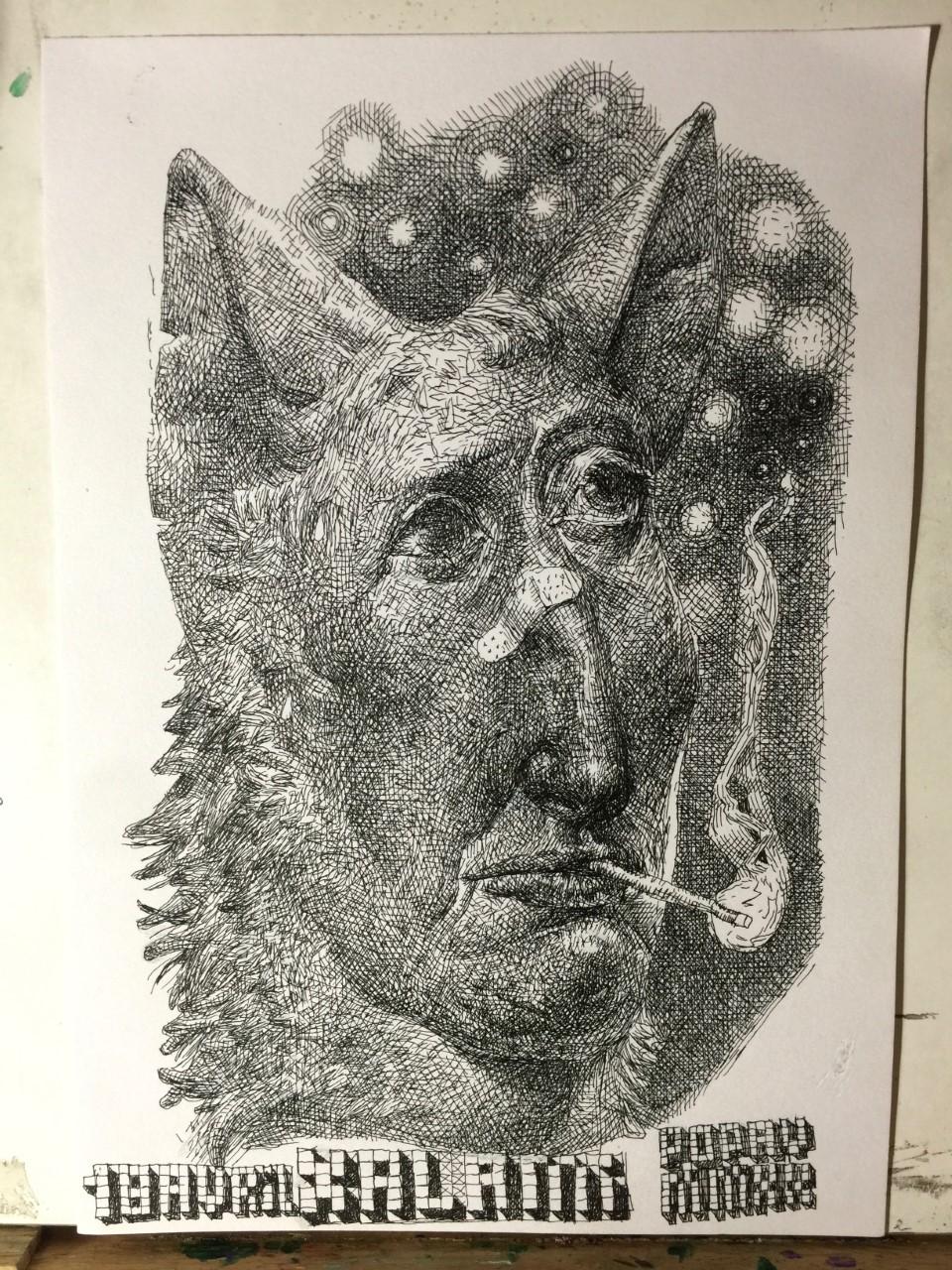
In an exercise in dexterity, I try to translate and make visible the spirit of a person in a portrait, or sometimes I try to bring out the animal aspect of the human or the humanity of the beast, thus concentrating on bringing a reflection of the living experience as much as possible. Above all, I try to avoid reproducing a supposedly realistic image, believing that there is more realism in expressiveness than in photographic likeness. I'm more attracted by the evocation of an expression, perhaps influenced by the spirit of the comic strip that so influenced me in my youth.
How do you think urban art has evolved in Paris since the 80s?
Even if a certain purity of approach in terms of motivation, technique and interest in style has been flouted, I think that even if more and more opportunities have presented themselves in terms of both surface and commercial interest, this movement remains a victory for all those who have supported it through decades of hard times and legal persecution.
What's the project you'd like to carry out that's closest to your heart?
I'd like to earn enough to be able to devote more time to digital experimentation, while continuing to deploy my imagination, imbued with my life experiences, on unexpected surfaces.
I'd like to settle near the place in France that was the origin of the tapestry technique, which enabled the deployment of a fantastic, magical and fairy-tale imagination, namely the Femme à la Licorne in Creuse. This would enable me to benefit from an environment more conducive and adapted to the exercise of my practice. So I'm keeping an eye out for opportunities that will give me access to this new dream world.
Find out more about Popay's work on his website.
Interview by Eleftheria Kasoura