
As an urban art center, Fluctuart takes you to meet the artists in order to better understand their creative process. See you today with Ërell.
Can you remind us who you are and your artistic practice?
Ërell, I’m an artist and designer; my work has its roots in graffiti. I practice a form of “urban contamination,” which involves the systematic and compulsive installation of abstract compositions in urban spaces. I generally act spontaneously, without authorization, in response to the architectural context, and install my compositions using cut-out adhesive pieces on the walls and street furniture of the cities where I work.
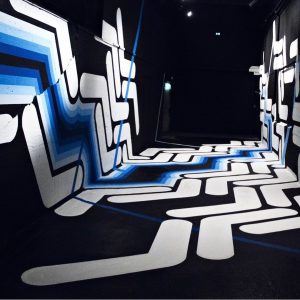
The module I use results from the splitting of a simple geometrical shape, the hexagon, itself resulting from a schematization of my tag. From this practice, I have retained the energy that transforms typography into a visual emblem, a logo, modular and adaptable, but also the viral character, alive from the multiplication of the motif. The goal is to sporadically invade public spaces like the tags that swarm on the walls of the city and give life to it.
By invading the streets of the cities in which I intervene, I seek to break the monotony of public planning, bring life back to life through plastic interventions whose formal vocabulary is analogous to forms found in nature, and modify the apprehension that passers-by have of urban space by inviting them to look around the streets for signs scattered along the way.
In my studio work, I always use these forms which are my signature, my writing. It becomes a pretext for experimentation, serves me to play with the different materials I use. It is in particular a search for balance between the full, the empty, the forms and counter-forms that can also be found in typography.
I use different techniques and know-how (working with wood, metal, die-cutting, painting on glass or concrete…) notably acquired during my training as a designer.
My signature then becomes a pretext for plastic experimentation and urban exploration.
What is your background, how did you start creating?
I began studying Applied Arts in 2003, which turned out to be a lifesaver for the rest of my studies. It was in Avignon, the city where I’m from. During my high school years, I was deeply interested in graffiti—which I was already doing—and later in the work of artists who stood out within the movement for their unique approach to street art (Zevs, Olivier Stak, Above, Space 3, El Tono, André, L’atlas…). During this period, I sought out modes of expression and representation beyond pure lettering, with a particular interest in minimal art and the use of industrial processes to create works of art. I then enrolled in a BTS program in Product Design. At that time, I was just beginning to develop the designs I use today. In 2007, I created my first installation using scissor-cut patterns; I covered a room from floor to ceiling and lived there for about a year. After earning a CAP in cabinetmaking, I enrolled at the École Supérieure d’Art et de Design de Saint-Étienne in 2009. It was thanks to this environment and the various people I met during my studies that I was able to develop my die-cutting production method, which allowed me to optimize my production time so I could spend more time on the street. In 2011, I participated in my first street art festival in Bordeaux, the “Interactive Design Festival,” organized by Les Grandes Traversées and curated by Mark Jenkins. It was through this festival that I began to take to the streets with my designs in a more intensive and methodical way. Throughout my studies, I continued to develop my street art practice in parallel, drawing on design in a cross-disciplinary way.
In 2015, I met Nicolas Laugerro Lasserre and it is from this moment that I was able to present my work in my first solo show at Artistik Rézo and thus deepen and develop my workshop practice….
In your daily work as an artist, what inspires you? What is the trigger for the creation of a work?
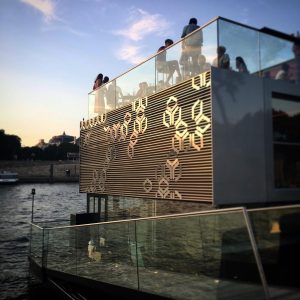
Generally speaking, I work in reaction to a context. Whether it is in the street or in my studio, the starting point remains the support. For example, for the installation created on the sides of Fluctuart, I used the same material as on the sides of the boat so that it would resonate with the place. I then generate my compositions and determine their scales according to the space available to me. As for the workshop productions, I compose according to the plastic and physical qualities of my support and its construction.
Can you explain to us how you build a work? What are the different stages of creation?
As I told you above, it can start either from a sentence that pops into my head, or from an image that struck me. Then I'm going to feed this sentence with images or this image with a sentence that it will evoke to me, and thus bring new elements that will feed the meaning.
Once I have all my elements I scan them to have them available and then create the street play. I edit the piece in volume, and then with the scanned elements I create an alias for the street. Not a carbon copy, something for the street that comes from the studio room. It's about adapting the speech to the audience it's intended for. Once the studio piece and the street piece are completed, I move on to a new story... A new play...
Again, it depends on the context, the materials, or the medium. For example, in the 120B series, I start by salvaging wood—preferably solid wood—and I build a “grid” determined by the direction of the wood grain. This allows me to establish my guidelines and brings out the lines of force. The creation of the support is a compositional process in its own right; I retain the angles found in my modules, which provide the modularity of my graphic elements. Then I create a digital model from a photograph in order to arrange and build my composition and select my colors. On wood, I often use blue—the complementary color to the shades found in wood—to create a harmonious interplay of colors by playing with color contrasts. I also incorporate solids and voids to let the material shine through, making it an integral part of my color palette. This method works well for these types of pieces, but I take a different approach when painting on metal, for example. In that case, I let the material reveal its inherent qualities through corrosion processes that I channel into my compositions.
At the beginning of the year 2020 I also started a series of stencils on paper. For this one it's even different, because my goal is to experiment with color mixing, transparency, optical mixing, and the texture work that can be obtained by varying the pressure exerted on the spray can. For the last ones I made, I was inspired by the dress of some birds for the choice of colors.
Discover below Ërell, on Le Mur in Bordeaux
Find Ërell, on Fluctuart