
Miss Tic's provocative women attract attention and seduce passers-by in the streets of Paris, but also on Fluctuart. But they don't just charm us: they also use powerful words to make us think. Artistik Rezo takes us along to meet them.
What was your career path? How and why did you start painting on walls?
That was a long time ago, when I was doing street theater. Then I spent almost three years in the United States, at the very beginning of the eighties, and I saw the birth of hip hop and graffiti. When I came back to Paris, there were young art students painting in the streets using different methods: some were covering billboards, others were painting on fences. There were so many different techniques. All this did something to me and I decided to paint in the street. I used stencils because for me it was a technique that gave me the possibility of reproducing my images several times, and then very quickly I decided to add texts to the images, as I love poetry and literature.
Why did you decide to make your characters speak? How important are words and literature to you?
I love to read: for me, reading has been a great way of opening up to the world, to myself and to others, so it was also a way of giving back what I had received through this medium.
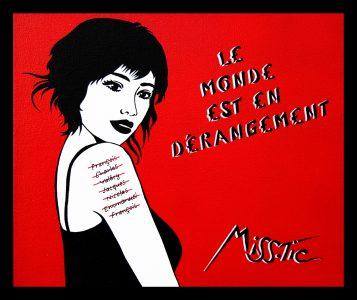
Where does your name come from, Miss Tic?
When I started out, it was a time when all artists took on pseudonyms. Miss Tic is the name of a witch who appears in Scrooge, a newspaper from Mickey's time. She's a Disney character. Scrooge is a very rich duck, and she, Miss Tic, is a bit of a loose cannon: she tries to steal his sou-fétiche, but never succeeds. I liked the image of the witch. Plus, she's a witch who fails at everything she does. And with this name, I was directly announcing that I was a woman.
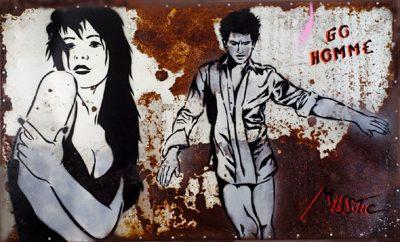
Women in the urban art world are still not as numerous as men. Was it difficult to break into this world when you first started out?
I've had no problems with other artists. After that, it's more complicated in the art market, and not just in street art. In the visual arts, for example, there are far fewer women than men. There are a lot of female graphic designers and illustrators, but fewer in painting and sculpture.
It's linked to the status of women: these are jobs where you have to be free because they're very demanding, and it's difficult to have a family. So socially, as soon as you have children, it's usually the woman who takes care of them. It's a mirror of society, and there's still a lot of work to be done.
The women you represent are very seductive, sexy and provocative, and the sentences they utter are very powerful and thought-provoking. What are your sources of inspiration, and is there a message you want to convey?
I don't think there's a message, I think the simple fact of being an artist is a way of being in the world.
But it's true that, as far as women are concerned, with my writing it was difficult to illustrate the words. At first I did self-portraits, but then I got a bit bored of working on my image. Then, somewhat coincidentally, but all at once, I used as a model this woman we see in the media like advertising and women's magazines, who is normally there to sell products. I wanted to make her say something.
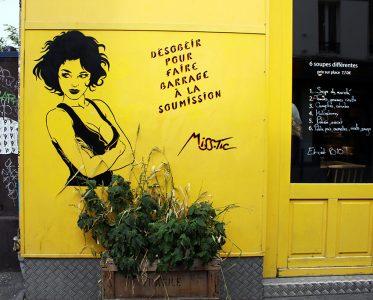
In fact, your characters are "perfect" women who completely embody the criteria of beauty.
Exactly, they're young, healthy and sexy.
Is that why you made this choice? Are they rebelling in some way with their words?
Yes, in other words, you can combine thought and femininity. At the same time, I'm not a militant either, I'm not doing this work to defend the cause of women. Because as women, I think we're all somewhat responsible for what happens to us, just as we are in the Western world when it comes to relationships, where, in that sense, we have the possibility of saying "no".
When it comes to the walls you paint, do you improvise or choose them in advance?
I do location scouting. I was convicted in 1999 for painting on walls. Up until then, I'd go out at night and choose the walls, but I was doing it illegally. After the conviction, as the proceedings were very long - they lasted two years - it made me think a lot. So I decided at that point to ask for authorizations.
Since then, I've gone to the shopkeepers and asked them for permission: on condition that I have carte blanche. That way, for the public, it doesn't make any difference and I don't have any more problems with the law or the police.
What are your plans for the future?
I have many projects that have been cancelled. I have a more distant project coming up, at Artazart, a bookshop-gallery specializing in graphic design and photography in Paris, which is celebrating its twentieth anniversary by reinviting artists who have done stints with them. It's a way of finding them again.
More information on the Miss Tic website.
Interview by Violagemma Migliorini.